Maybe Just A Bite

There is no such thing as nothing.
That may be the simplest answer to the oldest question in philosophy: Why is there something rather than nothing?
For thousands of years, philosophers have wrestled with the question. Religions have offered creation stories. Scientists have studied the origins of the universe. All have confronted the same mystery, usually beginning with the assumption that nothingness is a possibility.
But what if it isn’t?
What if the question itself contains a mistake?
We tend to imagine nothing as darkness. An empty universe. An endless black void where matter, energy, space and time have yet to appear.
But darkness is something. Empty space is something. Even a perfect vacuum, as physicists understand it, contains quantum fields. What we casually call nothing turns out to have properties that can be measured.
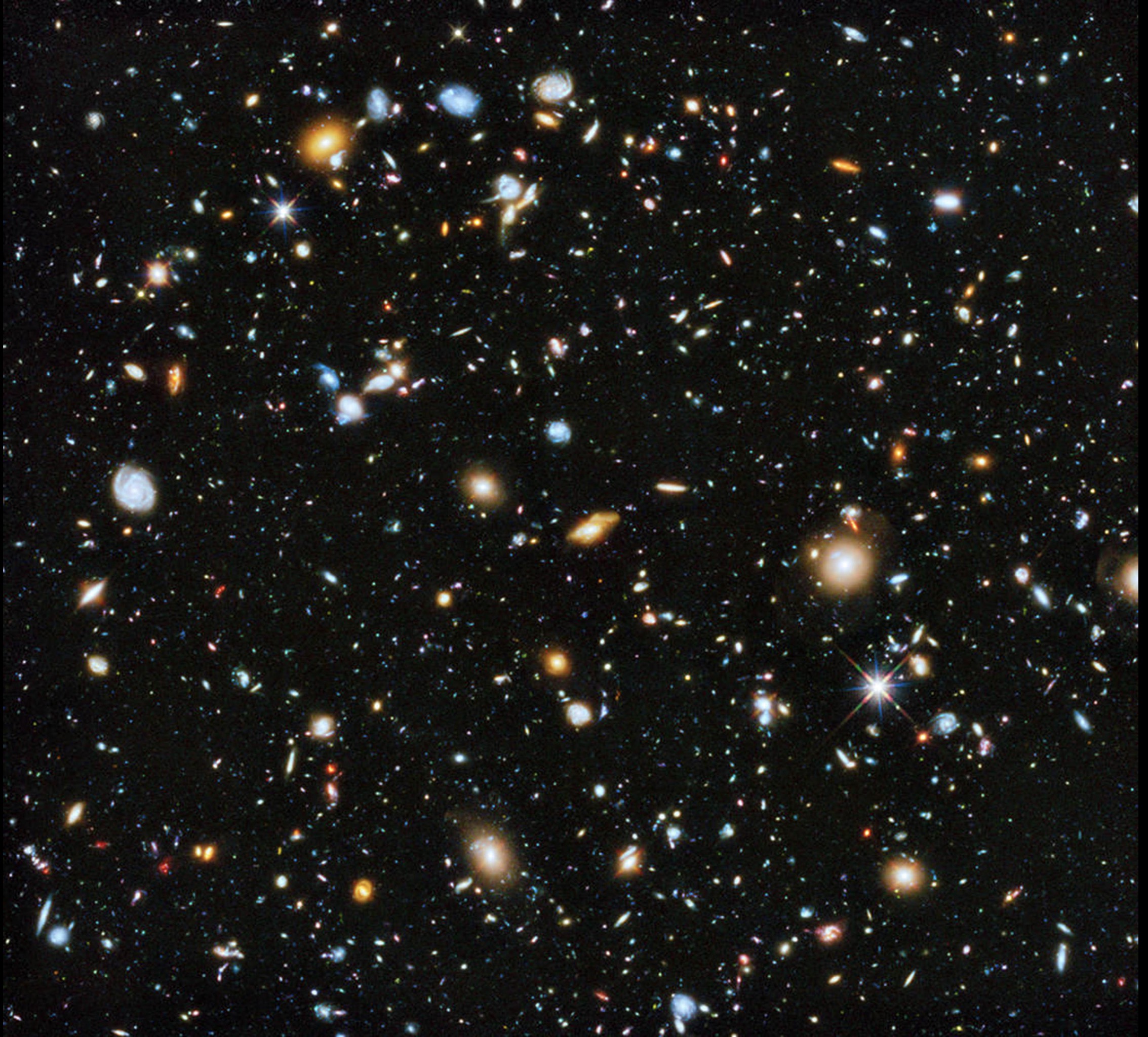
Take away the stars, planets and galaxies, and space remains. Take away the particles, and the quantum fields remain.
Now take away space itself. Remove time, energy, physical laws and every conceivable property of existence.
What remains?
We cannot point to it. We cannot measure it. We cannot even describe it without giving it some characteristic, which immediately makes it something.
Perhaps that’s because absolute nothingness is impossible.
This is a philosophical proposition, not a scientific discovery. Physics has never demonstrated that absolute nothingness cannot exist. But neither has anyone demonstrated that it can.
And we have one rather substantial piece of evidence on the other side.
Something exists.
If nothingness is impossible, then something must exist. It always has, in some form, even if that form bears no resemblance to the universe we recognize.
Suddenly, the great philosophical mystery changes.
The question is no longer why there is something rather than nothing.
The question becomes why something takes the form it does.
Why does existence produce a universe filled with galaxies? Why does energy take the form of matter? Why do atoms combine into molecules, molecules into living organisms, and living organisms into creatures capable of asking where they came from?
Here, at least, we have something more useful than speculation.
We have mathematics.
Einstein demonstrated the relationship between mass and energy with an equation simple enough to fit on a T-shirt: E = mc².
Newton described how gravity governs motion. Later, Einstein explained gravity through the geometry of spacetime. Quantum mechanics revealed mathematical rules governing the behavior of particles.
These discoveries did more than explain what scientists had already observed. They allowed scientists to predict things nobody had yet seen.
Mathematics gave us a way to understand how the universe behaves.
The same mathematical relationships that govern the formation of stars also govern the atoms in our bodies. The chemistry that makes life possible follows physical laws. Evolution operates through processes involving variation, inheritance and natural selection, all of which can be studied mathematically.
Over billions of years, matter organized itself into increasingly complex forms.
Eventually, some of it began thinking.
And now a three-pound human brain can contemplate the mathematical relationships governing a universe roughly 13.8 billion years old.
That strikes me as a considerably more interesting mystery than imagining a cosmic emptiness waiting for something to happen.
Of course, mathematics leaves us with a question of its own.
Why should existence follow mathematical laws in the first place?
We can demonstrate that those laws work. We can test their predictions and build technologies around them. What we cannot yet establish is why reality possesses such mathematical structure, or whether mathematics describes that structure or somehow underlies it.
This is where my faith in mathematics begins.
It is a faith built on evidence, continually tested against reality, and open to revision whenever the evidence demands it.
I cannot prove that mathematics is the foundation of existence. But I can see its fingerprints on virtually everything existence does.
Perhaps we have spent thousands of years trying to explain why the universe emerged from nothing when nothing was never an option.
Perhaps existence was inevitable.
And perhaps the real miracle is the math that gives it shape.